From World War II until the 1990s, the area now known as Baldwin Park was used for military purposes. When the Orlando Army Air Station was established in 1942, it included an area much larger than what we now know as the Naval Training Center (NTC) Main Base. The air station also included areas now developed as the Audubon Park neighborhood, the Fashion Square Mall, Koger Office Center, and other surrounding properties, in addition to what is now Orlando Executive Airport.
After World War II the Orlando Executive Airport property was returned to the City of Orlando, and the Audubon Park, Fashion Square Mall, Koger Center and other properties were sold as the Air Station gradually reduced its operations. The Army Air Station became Orlando Air Force Base in 1947. The Air Force Base closed its doors in 1968 and the remaining property was turned over to the Navy for use as the country's third Naval Training Center. Over the next three decades NTC Orlando served as the training site of more than 650,000 Navy Recruits. The Main Base property was home to three major commands: the Recruit Training Command, the Service School Command, and the Nuclear Power School.
NTC Closure & Reuse The Federal Base Realignment and Closure Commission (BRAC) identified NTC closure in July 1993. Upon notice of the final decision of the BRAC, the City of Orlando initiated the development of a Base Reuse Plan to guide transition of base property and facilities to other uses in support of local goals for economic and community development. The base closure and redevelopment planning process was a community based, proactive planning approach that established direction for redevelopment and reuse of the NTC facilities and properties. The effort consisted of four stages: 1) Base Reuse Plan; 2) Business and Development Plan; 3) Urban Design Vision Plan, and 4) Selection of a development team.
Base Reuse Plan Following the Pentagon's decision to close the NTC, Mayor Glenda Hood appointed a Base Reuse Commission, made up of Central Florida business and government leaders, to identify alternative uses for the base. With financial assistance from the U.S. Department of Defense Office of Economic Adjustment (OEA) the city established and staffed an NTC Base Reuse Office, and hired a consulting team headed by BRW, Inc., to assist in preparing a Base Reuse Plan.
It took approximately eleven months to develop the Base Reuse Plan. A thorough inventory of the physical, environmental, and economic conditions of the NTC property and the surrounding neighborhoods had to be performed. This assessment led to the identification of the site's opportunities and constraints and the development of goals and objectives for the base's reuse. Several land use plans, which would achieve the established goals and objectives, were evaluated. The approved Base Reuse Plan was used by the Department of the Navy as the basis in preparing their Environmental Impact Statement. Throughout the entire process, public comments were solicited and incorporated into the plan. Residents were kept informed through public forums, newsletters, committee meetings, newspaper articles and television news broadcasts.
Urban Design Vision Plan The design phase of the redevelopment process began in early 1997, approximately two years after the Base Reuse Plan had been approved. A consultant team headed by A. Nelessen Associates was hired by the city to prepare a detailed Urban Design and Transportation Plan using the approved Base Reuse Plan as a guide. A second consultant team, led by Post, Buckley, Schuh & Jernigan (PBS&J) and WBQ Inc., was hired to design a supportive Infrastructure Plan.
Citizen input was a valued component of the design process. A Visual Preference Survey was conducted to determine the type of development area residents desired for the NTC property. At three different meetings, citizens viewed and rated 240 slides depicting single-family homes, multifamily homes, pedestrian areas, transit possibilities, commercial land uses, offices, streets, parking, signs, and civic buildings. The survey results were presented at an all-day workshop where residents rolled up their sleeves, grabbed markers and put their ideas down on paper to convey how they would like to see the area developed. At the end of the day, several themes stood out - linking the site with surrounding neighborhoods, providing public access to lakes, using open space to form a network of green spaces throughout the project, creating a vibrant main street, and dispersing automobile traffic through a gridded street network. Using these themes, the Nelessen team created an Urban Design Plan implementing these ideas using Traditional Neighborhood Design Principles (TND).
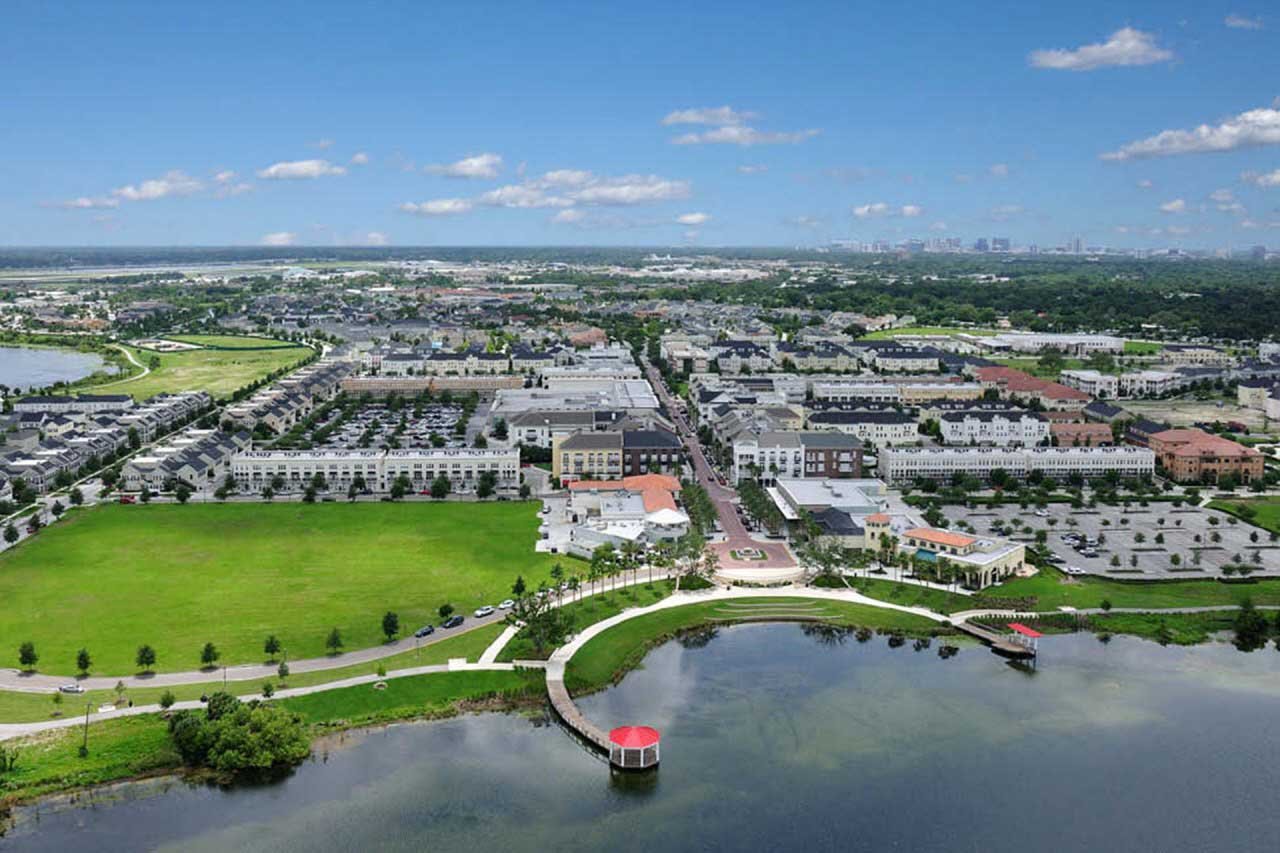
he Vision Plan presented a complete development concept. The plan provided for balanced long-term growth with approximately 3,000 residential units and more than 2,700,000 square feet of office/commercial use at buildout. A pedestrian-oriented village center, which included retail, office, and high-density residential uses, surrounded by high density residential areas was the focus. The two lakes on the site were cited as public space and an open space corridor linked the lakes with parks and other open space areas, thereby connecting it with wildlife corridors in the surrounding areas.
This process not only produced a clear concept of community expectations, but also resulted in a set of design guidelines that could be implemented. The stage was set, the community set the bar and challenged the development sector to come forward and improve on our vision.
Conveyance With a development team in place, the city of Orlando intensified efforts to acquire the Naval Training Center property from the Navy. On October 27, 1999, six years after the Navy announced the closure, the Orlando City Council voted unanimously to purchase the property from the Navy and moments later voted to sell the property to Orlando NTC Partners. Under the terms of the agreement, the city would pay the Navy $1.2 million plus 75 percent of the price paid by Orlando NTC Partners. In addition, the developer was required to make a one-time payment of $3.5 million to a local Homeless Provider Trust Fund.
By selling the property to one developer, the city could eliminate blighted conditions and create a tremendous amount of taxable value. In addition, the redevelopment would create 200 acres of parks and open 250 acres of lakes to the public. Another 90 acres would remain as out-parcels for various federal operations, leaving only about 550 acres of developable property for new streets, parcels, and lots.
Conveyance With a development team in place, the city of Orlando intensified efforts to acquire the Naval Training Center property from the Navy. On October 27, 1999, six years after the Navy announced the closure, the Orlando City Council voted unanimously to purchase the property from the Navy and moments later voted to sell the property to Orlando NTC Partners. Under the terms of the agreement, the city would pay the Navy $1.2 million plus 75 percent of the price paid by Orlando NTC Partners. In addition, the developer was required to make a one-time payment of $3.5 million to a local Homeless Provider Trust Fund.
By selling the property to one developer, the city could eliminate blighted conditions and create a tremendous amount of taxable value. In addition, the redevelopment would create 200 acres of parks and open 250 acres of lakes to the public. Another 90 acres would remain as out-parcels for various federal operations, leaving only about 550 acres of developable property for new streets, parcels, and lots.
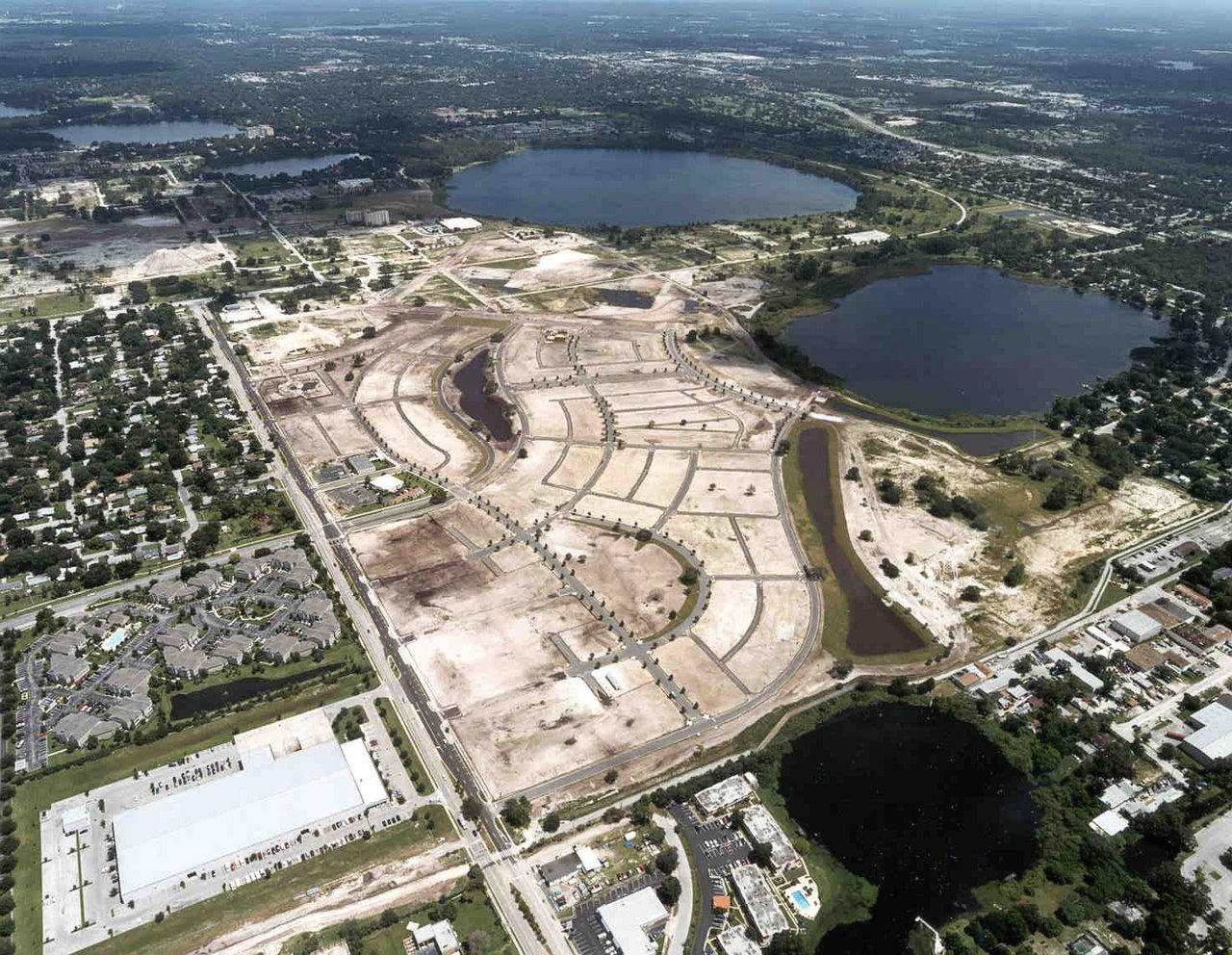
The sale to one developer also reflected the complexities of redeveloping a former military base. Before any new construction could begin, the developer first had to clear the site of 256 buildings (4.5 million square feet), excavate 25 miles of substandard roads and 200 miles of underground utilities, and remove contaminated soil discovered on the greens of the base golf course – at a cost of about $40 million.
Concrete and masonry materials from demolished buildings were crushed on-site and recycled in a massive underground stormwater filtration system and as road base for new public streets. Reusing 750,000 tons of recycled concrete on-site eliminated the 40,000 truck trips it would have taken to transport waste materials to a landfill.
A pair of federal lawsuits filed by a local resident further complicated redevelopment of the NTC property. The resident claimed that the Navy did not follow the proper procedures when it offered the land and buildings to other federal agencies. The first lawsuit died when the appellant missed a deadline for filing a petition in U.S. Supreme Court. An appeals court dismissed the second lawsuit.
The Land Use Program in Chapter 3 of the PD illustrates the anticipated type and amount of development that will be allowed at build-out. Actual development may exceed the anticipated Land Use Program if consistent with the entitlements provided in Growth Management Plan (GMP) Future Land Use Element Subarea Policy 16.4. The Subarea Policy includes office to residential conversion factors that can be used to convert office entitlements into an equivalent number of residential dwelling units. The Land Use Program has been amended six times since adoption in 1998. The current program generally allows the following development:
- Village Center Commercial - 310,000 SF
- Village Center Office- 250,000 SF
- Other Office - 614,798 SF Civic - 244,362 SF Residential DUs - 4,400 (plus 178 dwelling units in Building 310 at 4500 Lower Park Rd)